A Review of the Biochemistry Seminar Presentation on
Viruses and MicroRNAs
First exposed to the concepts of genetic regulation, gene mutation, and gene silencing in introductory biology courses, many of us are
aware of the immense impact that various types of microRNA have upon both the
genotypic and phenotypic expressions. Intercepting messenger RNA strands before
they have a chance to reach the ribosome for translation, regulatory
strands of microRNA have the ability to completely destroy individual messenger RNA
strands and ultimately control everything from cellular functioning to major
metabolic processes in the human body. (Krough, 255)
On October 24, Dr. Bryan Cullen of the Center for Virology,
Molecular Genetics & Microbiology at Duke University Medical Center presented
UNCG audience members with new insight into specific interactions between both human microRNA and such viruses as the Epstein-Barr virus and the Herpes Simplex Virus. Using such technologies such as PAR-Clip and PARalyzer in his lab, Dr.
Cullen has uncovered new evidence that suggests both the ability of certain viruses
to quickly replicate inside the human body is due to their successful
manipulation of human microRNA and that this overall manipulation of human microRNA can be directly linked to a variety of cancers later on in the lifespan.
Insight into the Epstein-Barr Virus
 |
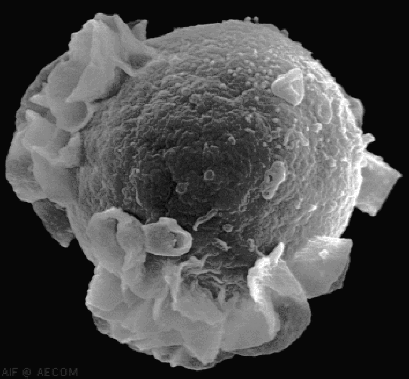
| Photo of EBV |
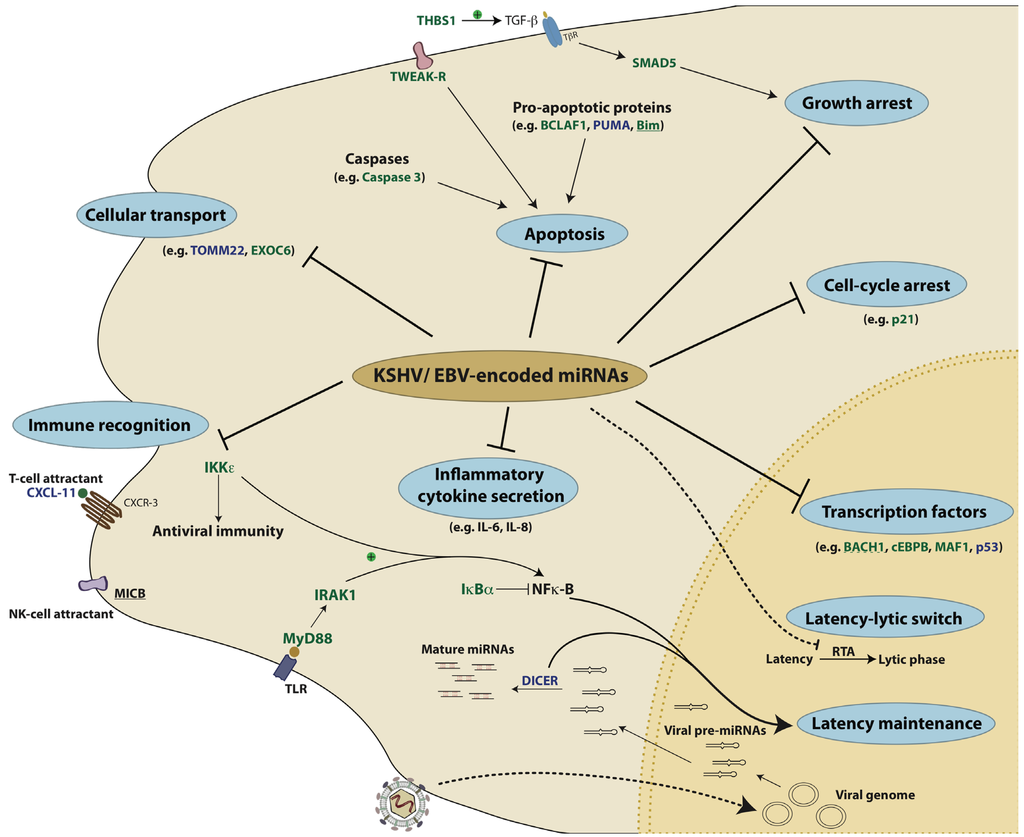
Infecting nearly 90% of the adult population and known to lead to the development of B-Cell Lymphoma and Nasopharyngeal Carcinoma later in life, the Epstein-Barr Virus was one of the first viruses that Dr. Cullen's research team investigated. In his 2012 Pathogens article, Dr. Cullen's research team demonstrated that a good portion of the virus's success in replicating and infecting this tremendous segment of the population was due to its ability to manipulate three specific types of human microRNA (miR-155, miR-146a, and miR-21).
 |
| Graphic of EBV Cellular Pathways |
According to Cullen's research findings, the reasoning behind why EBV takes over these three specific microRNAs is because each of these microRNAs controls specific cellular pathways and cell signaling functions needed by the virus. Referencing miR-155 in a 2010 article published in the Journal Virology, Cullen's team found that miR-155 supplied the EBV with efficient episomal maintenance of the EBV genome, ability to block the cell from undergoing proliferation, and finally initiate cellular apoptosis.
Insight into the Herpes Simplex I Virus
 |
| Photo of Herpes Simplex Virus I |
With an equally impressive ability to reproduce and infect members of the adult population, Dr. Cullen's research into the the Herpes Simplex I virus has also uncovered evidence that supports the conclusion that viral manipulation of human microRNA is an integral part of this virus's overall physiology. In a 2013 article published in the Journal Virology, Cullen's Research team stated that the overall family of Herpesviruses are particularly efficient at manipulating a variety of human microRNAs in order to control both overall gene expression and cellular function.
 | ||
| Graphic of Herpes Simplex I physiology |
Speaking specifically to the interaction between the Herpes Simplex I virus and miR-H2-3p in a 2008 article published in Nature, Dr. Cullen's research team made conclusion that the ability of the Herpes Simplex I virus to manipulate miR-H2-3p microRNA might be directly connected to the ability of the Herpes Virus to incubate in the human body undetected for multiple months and then suddenly produce such symptoms as cold sores.
Conclusion
Although much of Dr. Cullen's UNCG presentation required a firm foundation in molecular biology, biochemistry, and genetics to fully appreciate the significance of his findings, I was interested to learn about his research, investigate his published findings, and can't wait to investigate these topics in more detail starting in next semester's Genetics and Cellular Biology courses!
Book References
Krogh, David (2011). Biology
A Guide To the Natural World (5th ed.). Boston, Mass: Pearson
Education, Inc. (pp. 255-259)
Picture References
Graphic of EBV
http://bioweb.uwlax.edu/bio203/s2009/weisser_mich/hugesmono.gif
Graphic of EBV Cellular Pathways
http://www.mdpi.com/viruses/viruses-04-01687/article_deploy/html/images/viruses-04-01687-g004-1024.png
Graphic of Herpes Simplex I Virus
http://www.newswise.com/images/uploads/2005/07/21/fullsize/HSV2.jpg
Graphic of Herpes Simplex I Physiology
http://journal.frontiersin.org/Journal/10.3389/fimmu.2014.00015/full

I had no idea that B-Cell Lymphoma affects 90% of the human population. That number is startling! I wonder if any of Dr.Cullen's research has investigated any drugs that prevent the manipulation of microRNA's? Viruses are so smart I wish I had attended this presentation it sounds interesting thanks for sharing!
ReplyDeleteThanks for commenting!
ReplyDeleteI wanted to make sure that I clarify the fact presented both in my blog posting(and in Dr. Cullen's presentation) that 90% of human adult population is directly infected with EBV (not B-Cell Lymphoma).
Here is a link to the United States National Institutes of Health that speaks directly to the statistic referenced above. (URL: http://www.ncbi.nlm.nih.gov/pubmed/11488990)
Dr. Cullen (and other scientists) have been able to demonstrate through their research, that a link exists between EBV and B-Cell Lymphoma (as well as other forms of cancer). Much of his UNCG lecture presentation spoke to specific evidence demonstrating this link (I felt that to fully appreciate his research evidence, one needed to have previous exposure to concepts presented in such scientific realms as cytogenetics, biochemistry, and bioinformatics).
Speaking specifically to your question about pharmaceutical therapies related to the manipulation of microRNAs, I was able to find a source for more information about this topic:
Article: "MicroRNAs as Molecular Targets for Cancer Therapy: On the Modulation of MicroRNA Expression"
Journal: Pharmaceuticals
URL: http://www.mdpi.com/1424-8247/6/10/1195
Hi Hart,
ReplyDeleteThank you for sharing this detailed summary of the seminar with us! I really enjoyed reading your blog!
Thank you,
Eni Minerali